Project Preproposals Being Accepted for $1.85 Million in Fisheries Habitat Grants
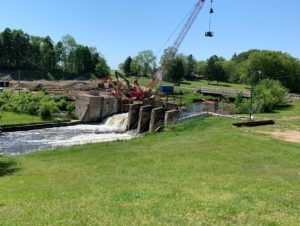
Contractors remove the Pucker Street Dam in Berrien County to improve connectivity, temperature and fish habitat on the Dowagiac River. Photo courtesy of the Michigan DNR.
According to a Michigan Department of Natural Resources (DNR) press release on Tuesday, Dec. 8, 2020, an expected $1.85 million is available in grant funding for fisheries habitat projects. Three themes dominate the grant funding this year and include aquatic habitat conservation, aquatic habitat and recreation in the Au Sable, Manistee, and Muskegon river watersheds, and dam management.
Joe Nohner, a resource analyst with the DNR Fisheries Division, outlined aquatic habitat protection and rehabilitation as the priority for grant projects. “Protection and rehabilitation of fish and other aquatic animals’ habitats are common to all three Fisheries Habitat Grant themes, because habitat degradation threatens Michigan’s fish and aquatic resources,” said Nohner. “The DNR prioritizes habitat conservation that targets the causes of habitat decline, such as barriers to connectivity, altered water levels or flow, and degraded water quality and riparian land – those transitional areas between land and water, like riverbanks.”
Grant amounts are starting at a minimum of $25,000 and have vast potential for more funding in each grant theme category. The DNR identifies priority projects through a project list held by the Fisheries Division, and those projects most relevant to the division’s priorities will receive preference when proposals are reviewed.
Project preproposals are due no later than January 8, 2021. For more information about this grant opportunity, visit the link to the DNR press release HERE .
The post Project Preproposals Being Accepted for $1.85 Million in Fisheries Habitat Grants appeared first on Michigan United Conservation Clubs.
Recent Posts